
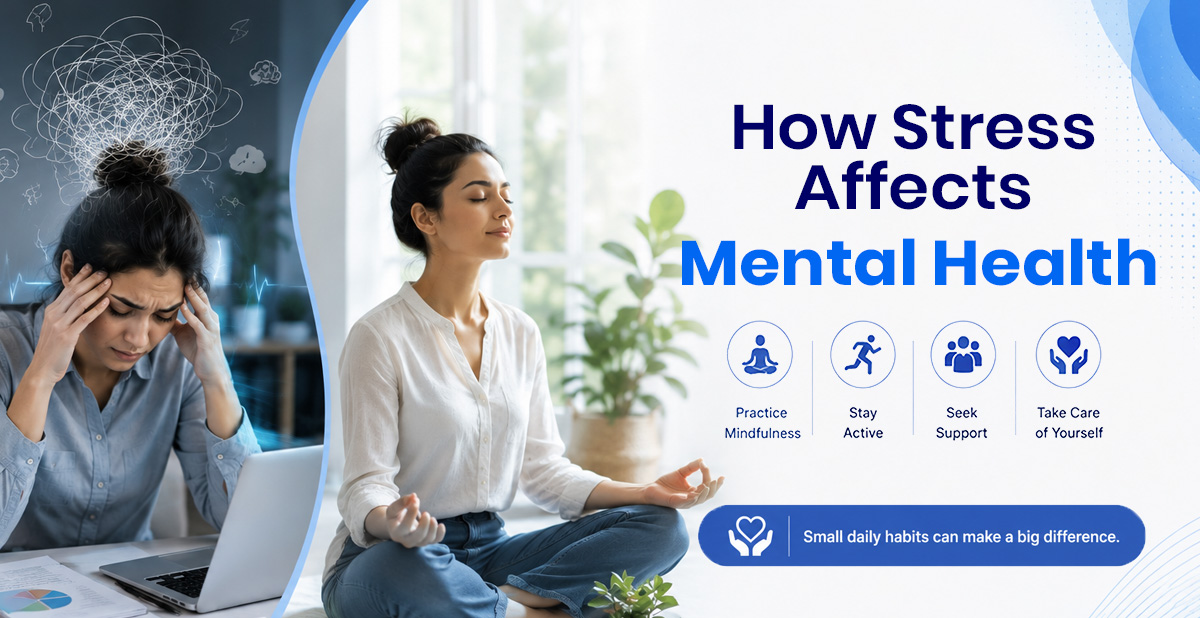
Everyone experiences stress. It’s the tight chest before an important presentation, the restless night before a big decision, and the low-grade exhaustion that builds up over weeks of overwork or worry. In small doses, stress is a normal, even useful, part of life. It sharpens focus and motivates action.
But when stress becomes chronic, when it doesn’t let up it stops being a signal and starts becoming a threat. To your sleep. Your relationships. Your physical health. And most significantly, your mental health.
This blog breaks down exactly how stress affects the mind and body, when it crosses into clinical territory, and the evidence-based strategies that genuinely help.
Understanding Stress: What’s Actually Happening in Your Body
Stress is a biological response. When you perceive a threat, whether it’s a deadline, a conflict, or a difficult piece of news, your brain’s amygdala triggers the release of stress hormones: primarily cortisol and adrenaline.
This is the ‘fight-or-flight’ response. Your heart rate increases, your breathing quickens, your muscles tense, and your body prepares for action. For short-term threats, this response is protective. The problem arises when the threat doesn’t go away.
Chronic stress means the body stays in this heightened state of persistently elevated cortisol, a nervous system that can’t properly ‘switch off,’ and biological wear on almost every system in the body. Over time, this has consequences that go far beyond feeling overwhelmed.
How Chronic Stress Impacts Mental Health
The link between stress and mental health is direct and well-established. Prolonged stress is both a trigger and an amplifier for a range of mental health conditions.
Anxiety Disorders
Stress and anxiety are closely related but distinct. Stress is typically triggered by an external cause; anxiety can persist even when the stressor is gone. Chronic stress rewires the brain’s fear circuitry, making the amygdala hyperreactive and lowering the threshold for anxiety responses. Over time, this can develop into generalized anxiety disorder (GAD), panic disorder, or social anxiety.
Depression
Prolonged cortisol elevation suppresses the production of serotonin and dopamine, the neurotransmitters that regulate mood, pleasure, and motivation. This is one of the primary biological pathways through which chronic stress leads to clinical depression. People under sustained stress often report low mood, loss of interest in activities they previously enjoyed, fatigue, and a pervasive sense of hopelessness.
Sleep Disruption
Cortisol is a wakefulness hormone. Elevated cortisol at night, which is common in chronically stressed individuals, makes it difficult to fall asleep, stay asleep, or achieve deep restorative sleep. Poor sleep, in turn, amplifies emotional reactivity and reduces the brain’s capacity to regulate stress. It becomes a self-reinforcing cycle.
Cognitive Impairment
Stress affects the prefrontal cortex, the area of the brain responsible for decision-making, focus, and rational thinking. Under chronic stress, concentration deteriorates, memory becomes unreliable, and people report feeling ‘foggy’ or unable to think clearly. This is not a personality failing; it is a measurable neurological effect.
Burnout
Burnout is a state of chronic stress that has reached emotional, physical, and cognitive exhaustion. It is characterized by a profound sense of depletion, increasing detachment from work and relationships, and a diminished sense of personal effectiveness. Burnout is now recognized by the World Health Organization as an occupational phenomenon with significant mental health implications.
Key Signs That Stress Has Crossed Into Something More Serious
Persistent low mood lasting more than two weeks
Inability to function at work or in daily responsibilities
Withdrawing from people and activities you previously valued
Physical symptoms with no clear medical cause (headaches, chest tightness, GI issues)
Thoughts of hopelessness, self-harm, or harming others
Ifyou recognizee these signs in yourself or someone you care about, professional support is the appropriate next step.
The Physical Toll of Mental Stress
Mental health and physical health are not separate systems; they are deeply interconnected. Chronic psychological stress has well-documented physical consequences:
- Cardiovascular disease: Elevated cortisol and adrenaline increase blood pressure and heart rate over time, raising the risk of hypertension, heart attack, and stroke
- Immune suppression: Chronic stress weakens immune function, making the body more susceptible to infections and slower to heal
- Gastrointestinal issues: The gut-brain axis is highly stress-sensitive; prolonged stress is associated with IBS, acid reflux, and disrupted digestion
- Hormonal disruption: Cortisol imbalances affect thyroid function, reproductive hormones, and insulin sensitivity
- Musculoskeletal pain: Persistent muscle tension from chronic stress contributes to headaches, back pain, and jaw clenching (bruxism)
This is why stress management is not optional; it is a legitimate healthcare priority.
Evidence-Based Coping Strategies That Work
Not all stress management advice is created equal. The following approaches are backed by clinical research and recommended by mental health professionals.
- Cognitive Behavioural Therapy (CBT)
CBT is among the most extensively researched and effective treatments for stress-related mental health conditions. It works by identifying and restructuring the thought patterns that amplify stress responses, helping patients develop more balanced, realistic interpretations of stressors. CBT is effective for anxiety, depression, insomnia, and burnout and can be delivered individually, in groups, or increasingly via digital platforms.
- Mindfulness-Based Stress Reduction (MBSR)
Developed at the University of Massachusetts, MBSR is an 8-week structured program that teaches mindfulness meditation and body awareness practices. Clinical trials consistently show it reduces psychological distress, lowers cortisol levels, and improves emotional regulation. Even a daily 10-minute mindfulness practice has measurable effects on stress perception and anxiety.
- Regular Physical Exercise
Exercise is one of the most powerful and accessible mental health interventions available. Aerobic activity, brisk walking, cycling, and swimming reduce cortisol, increase endorphins, and promote neuroplasticity. Research shows that 30 minutes of moderate exercise, three to five times a week, is as effective as antidepressant medication for mild to moderate depression. Movement is medicine.
- Sleep Hygiene
Because stress and sleep disruption form a reinforcing cycle, improving sleep quality is a high-leverage intervention. This means consistent sleep and wake times, limiting screens before bed, keeping the bedroom cool and dark, and avoiding caffeine after 2 PM. For those with clinical insomnia, Cognitive Behavioral Therapy for Insomnia (CBT-I) is more effective long-term than sleep medication.
- Social Connection
Loneliness amplifies stress; social support buffers it. Research shows that strong social connections are one of the most protective factors against mental illness. This doesn’t require large social networks; even one or two trusted, consistent relationships significantly reduce the mental health impact of stress. Prioritizing connection is not a luxury; it is a clinical recommendation.
- Structured Problem-Solving
Much chronic stress stems from feeling overwhelmed by unresolved problems. Structured problem-solving, identifying the specific stressor, listing possible responses, evaluating options, and committing to an action reduce the ambiguity that feeds anxiety. Breaking large, vague problems into small, concrete steps restores a sense of control.
- Diaphragmatic (Deep) Breathing
Slow, controlled breathing directly activates the parasympathetic nervous system, the body’s ‘rest and digest’ response. Techniques like box breathing (inhale for 4 counts, hold for 4, exhale for 4, hold for 4) or the 4-7-8 method can reduce acute stress responses within minutes. These are tools a patient can use anywhere, at any time.
When to Seek Professional Help
✓ Stress has persisted for several weeks with no improvement
✓ Stress is interfering with work, relationships, or daily functioning
✓ Coping strategies tried on your own are not providing relief
✓ You are using alcohol, substances, or avoidance behaviours to manage stress
✓ You are experiencing symptoms of anxiety, depression, or panic
A psychiatrist or clinical psychologist can assess your symptoms and design a personalized treatment plan, which may include therapy, medication, or both.
The Role of Professional Therapy in Stress Management
Self-help strategies are valuable and genuinely effective for many people. But there is a level of stress and psychological distress where professional support is not just helpful; it is necessary.
A trained mental health professional brings three things that self-help cannot: an accurate clinical assessment, a personalized treatment plan, and a therapeutic relationship that is itself healing. Research consistently shows that people with moderate to severe stress-related conditions recover faster and more completely with professional support.
Psychiatrists can evaluate whether there is an underlying biological component such as a mood disorder, anxiety disorder, or hormonal imbalance that requires medical management. Psychologists and psychotherapists provide structured, evidence-based therapy. Both work in partnership for comprehensive care.
Seeking help is not a weakness. It is the most rational response to a problem that exceeds what you can manage alone.
A Note on Stress in the Indian Context
In India, stress carries particular cultural weight. Academic pressure begins early and intensifies through competitive examinations. Work culture in many sectors normalizes long hours and chronic overextension. Family expectations, financial pressures, and social obligations layer additional demands on already stretched individuals.
At the same time, mental health stigma, though declining, remains a significant barrier to seeking care. Many people manage years of clinical anxiety or depression as ‘just stress,’ delaying treatment that could have prevented significant suffering.
Mental health is not a Western concept or a privilege. It is a universal human need, and effective, accessible treatment is available.
Final Thought
Stress is not a character flaw. It is not a sign that you are weak, incapable, or failing. It is a signal one that deserves to be taken seriously.
When stress is managed well, the body and mind recover. When it is left unaddressed, it compounds over time into conditions that are harder to treat and more disruptive to life. The investment in managing stress through lifestyle, support, therapy, or medical care is an investment in every dimension of your health.
If stress has been a constant companion for too long, today is a reasonable day to begin addressing it.